
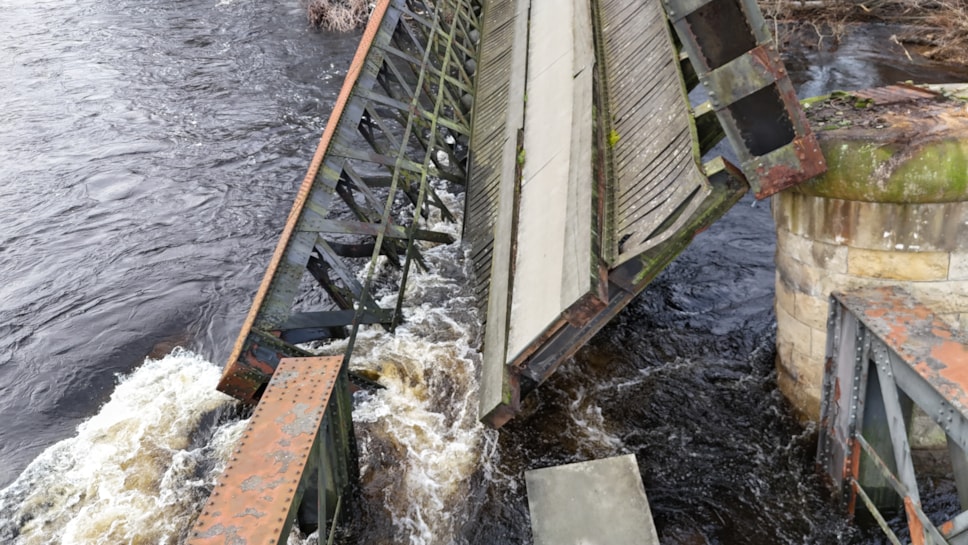
Garmouth/Spey Viaduct update - 15 December 2025
Statement following Moray Council engineer assessment and background information.
A Moray Council spokesperson said:
"Moray Council engineers have now assessed the Garmouth Viaduct and on initial inspection can confirm the collapse appears to be due to scour. At the time of the last scour report, by a specialist contractor in 2023, there was no evidence of scour. It appears that over the last year the river flow path has changed, which may have contributed to a change of impact on the piers. We're in the process of instructing a specialist engineer to undertake a more detailed inspection and assessment and hope that this can be progressed before Christmas or early in the new year.
“In the immediate future the area around the structure will be made safe with clean-up works to avoid further damage with further detailed inspections necessary, by a specialist contractor, to determine any other works required. The longer-term future of the bridge will be considered in the new year after the initial clear up operation, with options presented to Councillors as soon as practicably possible. We’re well aware of the strength of feeling in the local community, and further afield, for this bridge and how well used it is by walkers and cyclists.
“We are installing more robust fencing around the bridge to ensure the safety of the public. The message remains for members of the public to avoid the immediate area, both on land and river users, and not to climb on any part of the bridge for their own safety. While we understand local residents are keen to photograph this historical moment in the life history of the bridge it’s not safe to go under the bridge or climb the structure at this time.”
Background information and answers to frequently asked questions
Q1. When was the viaduct last inspected?
Garmouth Viaduct had a General Inspection by Moray Council's qualified bridge inspector in May 2025. The findings of the inspection in May was the steelwork in all three spans requires to be painted. Some section loss was evident in the lap joints. The bridge foundations could not be inspected safely. The bridge piers had mortar loss and one of the upstream piers was cracked. The bridge surfacing showed signs of timber decay present and there were loose bolts. The river bed showed signs of scour at the east span and erosion was present on the embankments. Repair works are considered a high priority on the list of non-network bridges and a bid would be made for future years in the capital plan.
The viaduct formed part of the regular General Inspection schedule in Moray, a General Inspection is done every three years and is a visual check of all parts of the bridge that can be easily accessed. It does not assess underwater areas due to the fast flowing nature of the Spey and specialist support required.
The last assessment carried out by a specialist bridge engineer was in 2023 and this more detailed assessment concluded there was no evidence of scour at the time and the abutment being built on rocks should not be an issue. However, the change to the flow path of the river may have since impacted the pier.
Q2. What caused the viaduct to collapse?
Scour is the process where fast-moving water erodes soil, sand, or gravel from around a bridge’s foundations, piers, or abutments. Over time, this washing away of material can undermine the support structures, making the bridge unstable and, in severe cases, leading to collapse.
In simple terms, it’s like water digging out the ground that holds the bridge up. If too much material is removed, the bridge loses its footing and can fail.
It appears that over the last year the river flow path has changed. At the time of the last assessment by a specialist, in 2023, there was no evidence of scour.
Q3. Can 39 Engineer Regiment at Kinloss rebuild it or replace it?
This is not an immediate solution but may be considered further if appropriate.
Q4. How long will the bridge be closed for?
There is no immediate solution to get the bridge in a sufficient state to re-open. Specialist contractors will need to be brought in for the clean-up operation and to determine next steps. As the bridge spans the fastest flowing river in Scotland, accessing the underwater areas is dangerous and requires specialist contractors and equipment. The initial work taking place will be dependent on availability of resources and funding.
Q5. What is the future of the bridge?
Any work to prepare options for the future of the bridge, potentially repair or replace, will begin in the new year. Any work on the bridge will also be subject to available finances.
The bridge is a listed structure so relevant partners and statutory bodies, such as the Council's Planning service, are being updated alongside Building Standards being notified of a dangerous structure.
History of the bridge
This viaduct, built from 1883-86, was constructed to carry the Moray Coast Railway, part of the Great North of Scotland Railway, over the Spey and its floodplain one mile south of the coast. The river crossing was initially conceived as three separate bridges spanning the disparate channels, but it was decided to divert the river into a single channel to be crossed on a viaduct with embankment approaches.
The viaduct, 950ft long, was built to carry a single-track railway. It has a 350ft long wrought-iron lattice bow girder span over the main channel of the river and three parallel-sided wrought-iron lattice girder approach spans of 100ft at either end. The lattice members of the main arch, 41ft deep at mid-span, rise from open box girders at each side of the deck. Cast-iron caissons filled with concrete form the piers of the viaduct. These were sunk to bedrock at depths of 25-35ft except for the piers at the west end of the central span where it was necessary to sink them to a depth of 75ft. It’s length was determined by the Spey's habit of periodically changing channels in the broad level plain near its mouth. The solution was to build a great bowed central truss with three plain truss approach spans on either side, all supported on circular ashlar piers with granite capitals. When completed the bridge was tested with a load of 400tons of gravel in 20 trucks, the bridge deflected by 29mm.
The viaduct, erected on a forest of staging, was designed by Blyth and Cunningham and Patrick Barnett, and the contractors for the ironwork of the superstructure were Blaikie Bros., Aberdeen. The contractor for the foundations and masonry was John Fyfe & Co., Kemnay.
At the time of construction, the main channel of the Spey ran to the east of the viaduct, and much of the construction work and work on the concrete spine wall to control the direction of the river was done in the dry. On completion of the bridge the river was diverted beneath the central span.
The structure is now part of the Speyside Way from Spey Bay to Ballindalloch.
It’s length (290m overall) was determined by the Spey's habit of periodically changing channels in the broad level plain near its mouth. The solution was to build a great bowed central truss, 106.6m long and 13m high, with three 30.5m plain truss approach spans on either side, all supported on circular ashlar piers with granite capitals. When completed the bridge was tested with a load of 400 tons of gravel in 20 trucks; the bridge deflected by 29mm.
The structure is now part of the Speyside Way from Spey Bay to Ballindalloch. Moray Council has maintained the bridge since 1968 when the railway line was closed.