
How road gritting works in Moray
A summary of information about Moray Council's winter maintenance work.
Winter Service Plan priorities
- Moray Council publishes a detailed Winter Service Operational Plan, identifying and prioritising roads, footways and cycle tracks, with Priority 1 being the highest priority for treatment, and Priority 4 being the lowest priority. This means that it won’t always be the case that all roads will be treated, with a focus on keeping the main road network and key facilities connected.
- Priority 1 routes (main connectors and heavy-traffic roads) account for 13 gritting routes, covering around 40% of the road network; these aim to be treated within 2.5 hours after cold weather sets in.
- Moray Council looks after 1563.9 km of roads with 594.9 km of Priority 1 roads.
Monitoring and forecasting
- Decisions are informed by daily Met Office forecasts along with live road surface temperature readings. We have 25 weather stations gathering data and feeding into our decision making.
- Treatments are usually pre‑applied before temperatures drop below freezing and the routes treated are updated on our interactive gritting map, refreshed twice daily.
Gritting operations and equipment
- There are 36 ploughs/gritters deployed across Moray with 50 operatives on the driver rota.
- 20 footpath ploughs/gritters also work across the region.
- We have capacity for 9,000 tonnes of grit to be stockpiled, which is brought in during the summer months.
- Gritters carry out pre‑planned runs on the Priority 1 network early in the morning, then continue onto lower-priority roads when conditions allow. They go out again in the evenings if appropriate with gritting operations running from 6am until 9.30pm, seven days a week including public holidays.
- Vehicle-mounted systems adjust salt spread dynamically, and tracked routes confirm coverage and serve as evidence of operations.
- Last year (2024/25) we treated 46,728 miles of priority one roads; used 12,520 tonnes of salt; recorded road surface temps as low as -12.6 celsius in January 2025; and carried out 1,706 winter actions.
Public co-operation and road safety
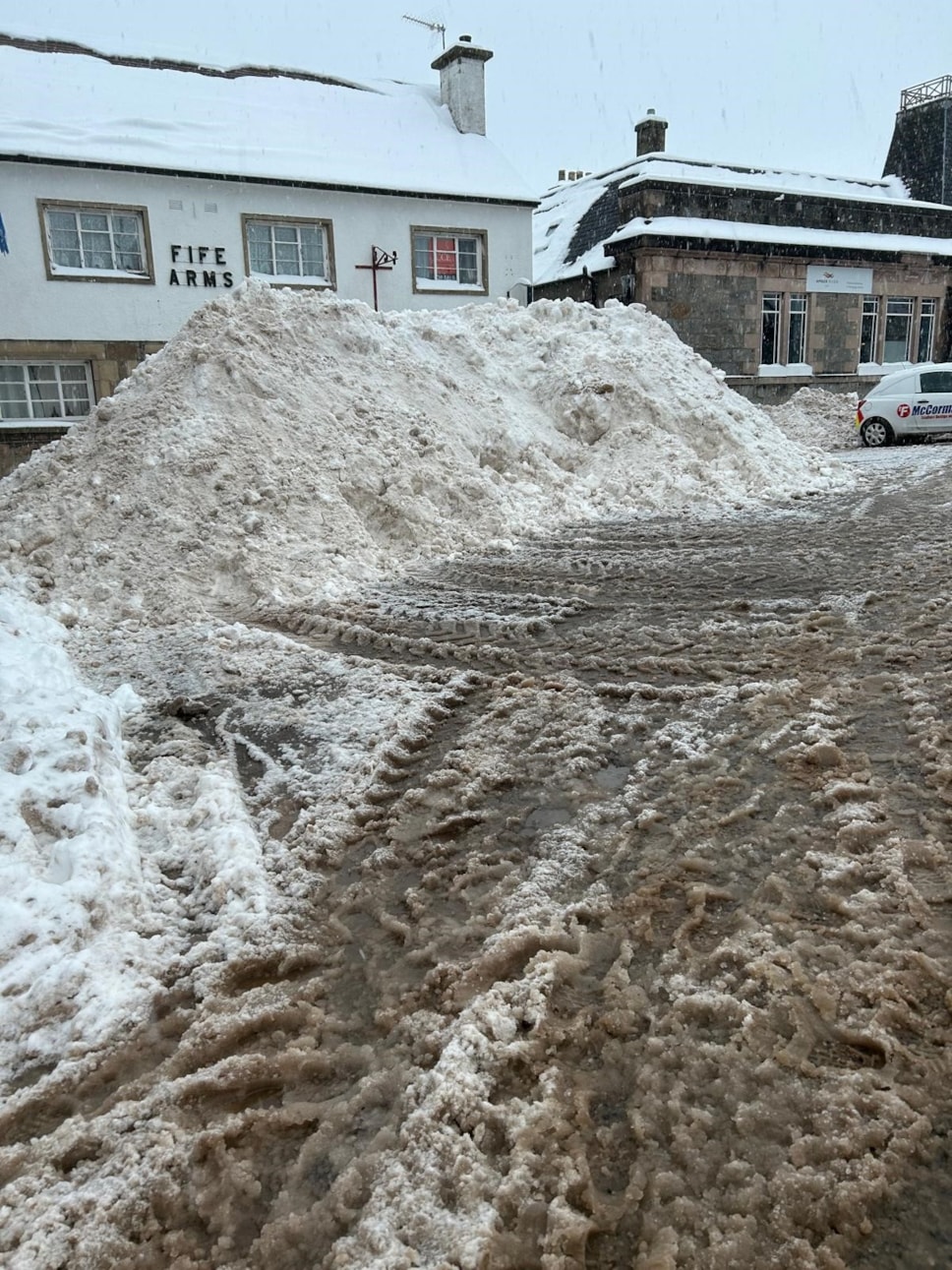
- Residents are encouraged to leave space for operators, not park over grit bins or on treated routes, ensuring access remains possible. Avoiding dumping snow from cleared driveways and footpaths in the middle of the roads is also appreciated.
- Where possible and residents are able to, they’re asked to clear driveways and paths and park in driveways to allow ploughs to get a clear run.
- Grit bin locations can be found online here and requests for refills should be completed on this map.
❄ Myth-Busting: gritting, snow and ice
|
Myth |
Reality |
|
Gritting prevents all ice/snow from forming. |
Salt lowers freezing points but doesn’t stop it entirely. Unless road temperatures remain mild, ice or snow can still accumulate, especially during heavy snowfall or at very low temperatures. |
| The road doesn’t need gritting if it is black tarmac and there is no snow forecast. | Ice can form without snow. Frost and black ice can occur when moisture on the road freezes, often overnight or early morning. The colour of the road doesn’t stop the surface temperature from dropping below zero. Roads lose heat quickly, especially in rural or exposed areas. |
|
Grit only applied after snowfall begins. |
Council gritters work proactively, treating before road temperatures dip below 0 °C. This helps prevent ice forming and makes it easier to keep roads clear. |
|
Once a gritter has passed, the road is instantly safe. |
Spread salt forms brine slowly. Traffic helps mix it in; until then, even on treated roads, conditions may remain slippery. |
|
More salt always means safer roads. |
Over-salting offers no extra benefit. Proper salting is carefully calibrated - too much is wasteful, costly and harmful to the environment. |
|
Salt works at any temperature. |
Salt’s effectiveness decreases below about –5 °C and stops altogether around –8 °C to –10 °C, depending on concentration. Our gritting schedules take that into account. |
Moray's winter service blends proactive forecasting, prioritised routes, modern equipment and real-time monitoring. While gritting significantly improves safety, it doesn’t guarantee perfect roads - particularly in deep snow or bitter cold.
Drivers should remain cautious, maintain sensible speeds, and respect gritters’ work to ensure maximum benefit from treatments.